

In February, the Washington State Medical Oncology Society (WSMOS), in partnership with Fred Hutch Cancer Center, hosted its second annual San Antonio Breast Cancer Symposium (SABCS) Review and GI Update. The meeting brought together oncology professionals from across the region to highlight key research findings from SABCS 2025 and discuss how these advances are shaping patient care. NWMS was proud to have both Dr. Ky Jung and Dr. Sibel Blau serve as presenters.
Dr. Jung on Predictive and Prognostic Biomarkers in Early-Stage Disease
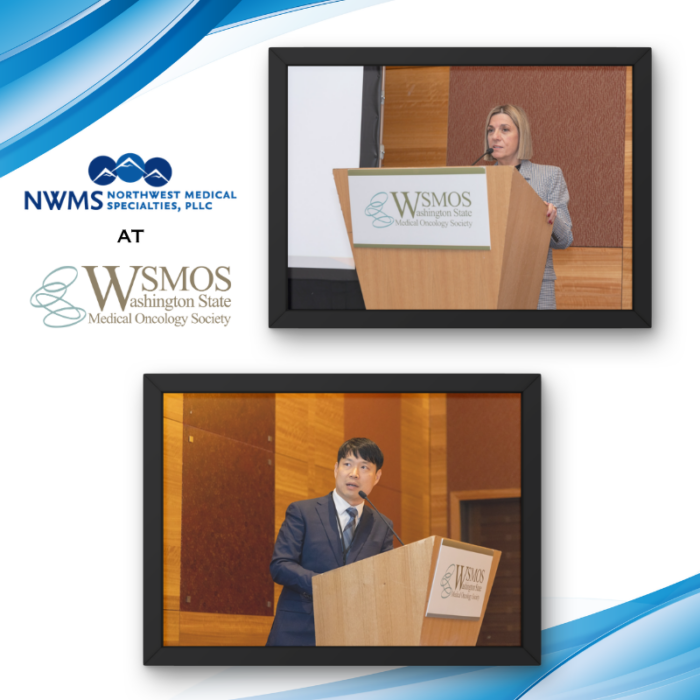
In his presentation, Dr. Jung reviewed new ways doctors are using blood tests and tumor features to better predict which early-stage breast cancers are likely to come back, and which patients may need more or less treatment.
One major focus of his presentation was tumor-infiltrating lymphocytes (TILs), which are immune cells found inside tumors. In general, tumors with more of these immune cells tend to respond better to treatment and are linked to better outcomes, especially in triple-negative breast cancer (TNBC). However, the amount of immune cells varies by breast cancer type, and there is still no universal agreement on what “high” or “low” levels should be. Research is also showing that combining immune activity with other tumor features (like how fast the cancer cells are growing) can improve risk prediction.
Another key topic covered by Dr. Jung was circulating tumor DNA (ctDNA), tiny fragments of cancer DNA that can be detected in a patient’s blood. If ctDNA is found after treatment, it strongly suggests that microscopic cancer cells remain in the body and that the risk of recurrence is much higher. Patients whose blood tests remain negative for ctDNA generally have a much lower chance of the cancer returning. These findings suggest that ctDNA could become a powerful tool to identify who might benefit from additional therapy after surgery.
Overall, Dr. Jung’s presentation highlighted a shift toward more personalized treatment in early breast cancer. By using immune markers and blood-based DNA testing, doctors may be able to better tailor treatment, reducing therapy for low-risk patients while intensifying it for those at highest risk. However, more research is still needed before these tools become standard in everyday practice.
Dr. Blau on Takeaways from SABCS 2025
Dr. Blau’s presentation reviewed some of the most important updates from the 2025 SABCS, focusing on new treatment options for different types of breast cancer.
One major topic Dr. Blau covered was hormone receptor–positive (HR+) early breast cancer. For many years, treatment after surgery has relied on hormone-blocking pills like tamoxifen or aromatase inhibitors. Now, newer drugs called oral SERDs (a stronger type of estrogen-blocking therapy) are showing modest but meaningful improvements. These drugs may be especially helpful for higher-risk patients or those who cannot tolerate other newer treatments like CDK4/6 inhibitors. The overall benefit is relatively small due to short duration of follow-up but is expected to improve over time. The newer approaches combining these drugs with CDK 4/6 inhibitor will change the landscape further. However, the cost of these medications is very high, which is an important concern. More research is ongoing to determine the best way to combine these drugs and to identify which patients benefit most. This is an exciting area of drug development with potential improvement in chances of long-term survival.
Another focus was HER2-positive metastatic breast cancer, where newer targeted therapies continue to improve outcomes. Ongoing trials are refining how best to combine these treatments to maximize benefit while managing side effects.
For triple-negative breast cancer (TNBC), several studies helped clarify the role of adding carboplatin chemotherapy to standard treatment. The data suggest that adding carboplatin improves outcomes, even in some earlier-stage patients. However, it also increases side effects. Because of this, the decision to include carboplatin should involve shared decision-making between the patient and doctor, taking into account the patient’s overall health, tolerance for side effects, and concerns about recurrence.
Overall, the presentation emphasized that breast cancer treatment is becoming increasingly personalized. Doctors now have more tools and more choices, but the key challenges remain balancing benefit versus side effects, considering financial impact, and identifying which patients truly need more aggressive treatment.